
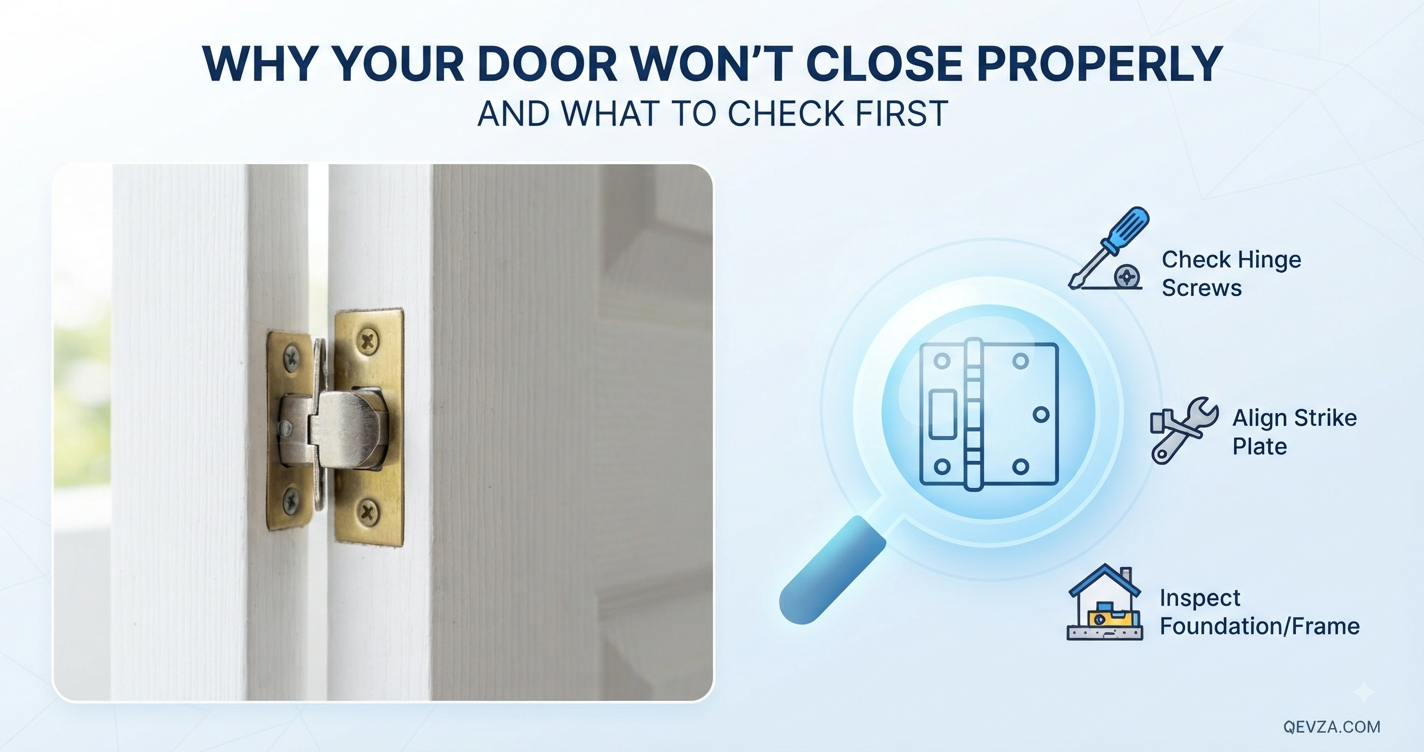
Few things are as quietly frustrating as a door that refuses to latch, scrapes against the floor, or bounces right back open the moment you let go. You pull it, push it, or give it a slight shoulder shove just to keep a room private or secure your home at night.
Most people assume the house is settling or the doorframe has warped beyond repair. Often, though, the fix is far simpler.
This guide walks you through what different door issues usually mean, how to safely inspect your door, and what you can do to fix or improve the situation without special tools.
What the Problem Usually Means
When a door refuses to close correctly, it almost always comes down to a physical alignment issue between two main components: the door slab itself and the surrounding frame.
Every door relies on precise geometry. The hinges hold the door in a specific position, allowing it to swing in an arc that matches the opening. If any part of this system shifts—even by a fraction of a millimeter—the latch will miss the strike plate, or the edge of the door will jam against the wood frame.
Pinpointing the symptom is the first step toward finding the right solution. A door that hits the top corner requires a different adjustment than one that catches on the threshold.
Common Reasons This Happens
Doors deal with daily stress, environmental changes, and mechanical wear. Understanding why the problem occurred helps you choose the right approach.
-
Loose hinge screws: The weight of a door pulls constantly on its hinges. Over time, the screws in the door jamb loosen, allowing the entire door to sag.
-
Seasonal humidity changes: Solid wood doors and frames absorb moisture from the air during humid months and dry out during winter. This expansion and contraction can make a door swell tightly into its frame.
-
House settling: Minor shifting in a home’s foundation can slightly distort doorframes out of square.
-
A loose strike plate: The metal plate on the door frame can shift out of alignment due to vibration from daily slamming or loose mounting screws.
What You Can Check Yourself
Before reaching for tools or planning a major repair, take a few minutes to inspect how the door interacts with its frame.
Close the door slowly and watch the gaps on all four sides. A properly hung door should have an even gap—about the thickness of a nickel—along the top and hinge sides.
-
Look at the gaps: If the gap at the top is wider on one side than the other, or if the latch side rubs against the frame, you likely have a sagging hinge.
-
Inspect the latch and strike plate: Look closely at where the latch bolt meets the metal strike plate on the frame. If you see fresh scratches or paint chips just above or below the opening of the plate, the latch is missing its target.
-
Check the floor clearance: See if the bottom edge of the door is dragging on the carpet, tile, or hardwood threshold.
[Internal link opportunity: article about how to fix a door that rubs on the carpet]
How to Fix the Problem
Once you spot where the door is binding or missing its mark, you can tackle the most common adjustments using basic household tools.
Tighten Loose Hinges
A sagging door is frequently caused by loose screws in the top hinge.
-
Open the door and check the screws on both the door edge and the door frame.
-
Using a standard screwdriver, tighten any loose screws.
-
If the screw holes have become stripped and won’t tighten down securely, remove the screw, place a small piece of a wooden toothpick or a small sliver of wood coated in wood glue into the hole, and drive the screw back in. The wood gives the screw something solid to bite into.
Adjust the Strike Plate
If the door closes but refuses to stay latched unless you pull or push on it, the latch plate may need a minor adjustment.
-
Clean the face of the strike plate and apply a small dab of lipstick or chalk to the tip of the door latch.
-
Close the door so the latch hits the plate. The lipstick will leave a mark on the strike plate or frame, showing you exactly where the latch is hitting.
-
If the mark is slightly high or low, you may need to file out a tiny bit of the metal strike plate lip using a round metal file, or reposition the plate entirely by filling the old screw holes and drilling new ones slightly higher or lower.
Common Mistakes to Avoid
When dealing with a stubborn door, it is easy to make adjustments that create new problems down the road.
-
Avoid immediately planing or sanding the door: Many people grab a power sander or hand plane the moment a door sticks. If the real issue is a loose hinge causing the door to sag, planing the edge will only leave an unsightly gap once the hinge is eventually fixed. Always check alignment before removing material.
-
Do not force or slam the door: Forcing a misaligned door stresses the hinges, damages the latch mechanism, and can split the wood around the lockset.
-
Avoid over-tightening screws with power tools: Using a high-powered drill on delicate hinge screws can easily strip out the wood fibers in the frame, making the hinge much looser than before.
When You Should Call a Professional
While most minor alignment issues are suitable for beginner DIY efforts, some situations require a carpenter, handyman, or door specialist.
-
Severe structural shifting: If multiple doors throughout the house suddenly stop closing, or if diagonal cracks appear in the drywall near doorframes, your home may be experiencing significant foundation movement that requires professional evaluation.
-
Hollow-core or specialized door damage: If the core of the door itself has split or the frame is severely warped from water damage, replacement is often safer and more practical than repair.
-
Heavy exterior or security doors: Heavy metal or solid wood exterior doors can be extremely heavy and awkward to handle safely. If they require major re-hanging, a professional ensures the security and weather-sealing remain intact.
How to Prevent the Problem in the Future
Doors give plenty of warning signs before they stop working completely. Regular upkeep keeps them swinging smoothly.
-
Check hinges annually: Once a year, walk through your home and check the hinge screws on high-use interior and exterior doors. Tightening a loose screw early prevents the door from sagging and wearing out the frame.
-
Manage indoor humidity: Running bathroom exhaust fans during showers and using air conditioning or dehumidifiers during peak summer humidity helps minimize the seasonal swelling of wooden doors.
-
Lubricate moving parts: Apply a small drop of household machine oil or silicone spray to the hinge pins once a year to reduce friction.
Frequently Asked Questions
Why does my door open or close all by itself?
If a door swings open or shut on its own, the hinges are likely out of plumb. This means the hinge pins are not perfectly vertical, causing gravity to pull the door in the direction of the lean. Removing one hinge pin and tapping it slightly, or shimming the hinges, usually corrects this.
Can weatherstripping prevent a door from closing?
Yes. If new weatherstripping was recently installed around an exterior door, it may be too thick, creating too much resistance for the latch to catch. Adjusting the position of the weatherstripping or the strike plate resolves this.
What should I do if the door rubs against the floor?
First, check for loose hinges that might be letting the whole door drop. If the hinges are tight and the door still scrapes the floor, seasonal humidity may have swollen the wood, or new flooring may have been installed with less clearance.
Final Thoughts
A door that won’t close properly is an annoyance, but it is rarely a mystery once you inspect the hinges and the latch alignment. By taking a methodical approach—checking for loose screws and tracking where the door makes contact—you can often restore smooth operation in just a few minutes with a screwdriver.