
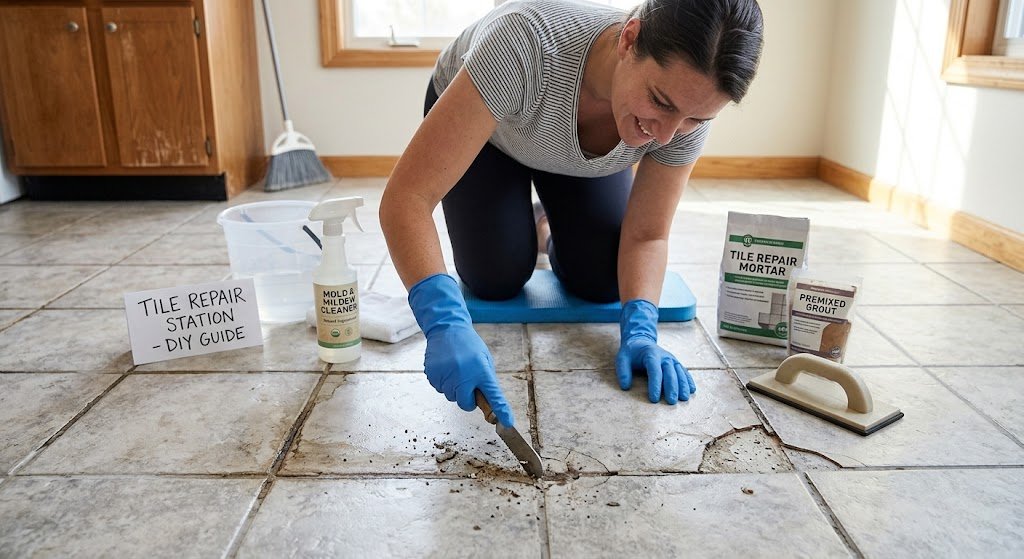
Tile floors and walls can last for many years, but they are not completely maintenance-free. Grout can crack, tiles can become loose, stains can appear and moisture can find its way into places where it should not be.
The good news is that many small tile and grout problems can be dealt with at home before they become more expensive repairs. A small section of damaged grout, for example, may only need careful removal and replacement. A loose tile may be repairable if the underlying surface is still sound.
The important part is knowing what has actually caused the problem. Cleaning a damp patch will not solve a leak, and adding new grout over loose or damaged material will not create a lasting repair.
This guide covers common problems found around tiled floors, walls, kitchens and bathrooms, with practical steps for deciding what you can reasonably tackle yourself and when professional help may be more appropriate.
Why Tile and Grout Problems Happen
Tiles themselves are generally hard-wearing, but the complete tiled surface contains several different materials.
There may be:
- Tiles
- Grout
- Adhesive
- Sealant
- Backing boards
- Plaster or masonry
- Flooring or subfloor materials
A problem with one part can eventually affect another.
Grout may crack because of movement in the underlying surface. A tile may become loose because the adhesive has failed. Persistent darkening around a shower may be caused by moisture rather than ordinary dirt.
This is why simply covering a visible problem is not always the right solution.
Before repairing anything, try to identify whether the problem is cosmetic, caused by normal wear, or a sign of a larger issue.
Cracked or Missing Grout
Cracked grout is one of the most common problems around tiled surfaces.
Small cracks can occur because of movement, age, impact or changes in the underlying surface. Grout can also become brittle over time.
How to repair small areas of damaged grout
For a small repair, start by removing loose and damaged grout.
Use an appropriate grout-removal tool and work carefully so that you do not chip the surrounding tiles.
Once the damaged material has been removed:
- Clean the joint and remove loose debris.
- Allow the area to dry if moisture is present.
- Prepare suitable replacement grout according to its instructions.
- Press the grout firmly into the joint.
- Remove excess grout from the tile surface.
- Allow it to cure according to the manufacturer’s instructions.
Do not simply smear fresh grout over cracked material.
The new layer may not bond properly and the original problem can quickly reappear.
When cracked grout needs more investigation
If grout repeatedly cracks in the same location, look beyond the grout itself.
Repeated cracking could indicate movement or another problem with the underlying surface.
If several tiles are cracking at the same time, or the tiled surface appears to be moving, professional assessment may be sensible.
Loose Floor or Wall Tiles
A tile that moves when you press it should not be ignored.
Loose tiles can result from failed adhesive, movement beneath the tile or problems with the underlying surface.
How to check a loose tile
Gently press the tile.
If it moves, listen for a hollow sound compared with nearby tiles when lightly tapped with a suitable object. A hollow sound does not by itself prove that a tile is loose, but it can be a useful indication when combined with movement.
Do not force the tile.
Can you fix a loose tile yourself?
A small, isolated loose tile may be repairable if the tile itself is undamaged and the underlying surface is suitable.
The general process involves carefully removing the tile, cleaning away old adhesive, checking the base and installing the tile with an appropriate adhesive.
The exact adhesive and preparation depend on the tile type and surface.
If the underlying material is damp, crumbling or moving, replacing the tile alone is unlikely to solve the problem.
Chipped or Cracked Tiles
Tiles can crack or chip after an impact, from heavy objects being dropped or because of movement beneath them.
A small surface chip may be mainly cosmetic.
A larger crack is more significant, particularly on a floor where the tile is subjected to regular foot traffic.
Small chips
Some minor chips can be repaired with a suitable tile repair product.
Follow the manufacturer’s instructions and match the colour as closely as possible.
This is most appropriate where the damage is small and the tile remains structurally sound.
Cracked tiles
A badly cracked tile will often need replacement rather than repeated filling.
Before replacing it, try to understand why it cracked.
If the same type of cracking appears repeatedly, there may be an underlying installation or movement issue.
Replacing one tile without addressing the cause could result in another crack later.
Stained Grout
Grout can become discoloured because of dirt, grease, moisture, cleaning residue or other substances.
In kitchens, grease and food residue can contribute to staining.
In bathrooms, persistent moisture can contribute to darker areas and biological growth.
How to clean stained grout
Start with a cleaner specifically suitable for the grout and surrounding tiles.
Apply it according to the manufacturer’s instructions.
Use a soft or medium-soft brush rather than an aggressive abrasive tool.
Work in small sections and rinse when required.
Do not assume that increasingly strong chemicals will produce better results.
If the grout remains discoloured after appropriate cleaning, it may be permanently stained or the problem may have another cause.
Mould or Mildew Around Grout
Dark spots around bathroom grout and sealant can sometimes be caused by mould or mildew.
Cleaning may remove surface growth, but recurring growth deserves further attention.
Look at the environment around the affected area.
Is the room poorly ventilated?
Does water remain on the surface for long periods?
Is a sealant joint damaged?
Could there be a leak?
Simply cleaning the visible area repeatedly may not address the reason it keeps returning.
When dealing with mould, follow appropriate household cleaning and ventilation guidance, and never mix cleaning chemicals.
If there is extensive growth or an underlying moisture problem, professional advice may be appropriate.
Grout That Is Turning Powdery
Grout should not normally be continually crumbling into powder.
If you notice loose material falling from joints, investigate the cause.
Possible reasons can include:
- Age
- Moisture
- Poor installation
- Inappropriate cleaning
- Movement
- General deterioration
Small areas may be repairable by removing the failed grout and replacing it.
However, widespread deterioration suggests that the tiled installation needs a closer inspection.
Gaps Between Tiles and Other Surfaces
You may notice a gap where tiles meet:
- A bath
- Shower tray
- Worktop
- Wall
- Floor
- Sink
Not every joint should be filled with ordinary grout.
Some areas require flexible sealant because they can experience movement or moisture.
For example, the joint between a tiled wall and a bath may need an appropriate sanitary sealant rather than rigid grout.
If an existing seal has cracked or separated, remove the failed material and replace it with a suitable product according to its instructions.
If water is getting behind the joint, investigate the source rather than simply covering it.
Cracked Silicone Sealant
Sealant is often used around baths, showers and sinks.
Over time, it can:
- Crack
- Shrink
- Separate
- Become discoloured
- Develop gaps
Once a seal has failed, cleaning it will not restore its waterproof function.
How to replace a small section of sealant
For a straightforward DIY repair:
- Remove the old sealant carefully.
- Clean away residue.
- Make sure the surfaces are clean and dry.
- Apply suitable sanitary sealant.
- Smooth the new bead according to the product instructions.
- Allow it to cure for the specified time before exposing it to water.
Do not rush the curing stage.
The manufacturer’s instructions should take priority over generic advice.
Tiles That Sound Hollow
A hollow sound when tapping a tile does not automatically mean that it needs replacing.
Some tile installations can naturally produce different sounds depending on what lies beneath them.
However, if a hollow-sounding tile is also loose, cracked or moving, it deserves closer attention.
Look for other signs such as:
- Movement underfoot
- Cracked grout around the tile
- Cracks in the tile
- A noticeable change compared with surrounding tiles
The combination of several symptoms is more useful than sound alone.
Lippage Between Tiles
“Lippage” refers to a difference in height between adjacent tiles.
You may notice one tile sitting slightly higher or lower than the one next to it.
Minor differences can occur during installation.
More pronounced lippage can create:
- A trip hazard
- An uncomfortable walking surface
- Difficulty cleaning
- Places where dirt collects
If the tiles were recently installed and the difference is significant, contact the installer before attempting a DIY repair.
If an older tiled surface has developed movement or height differences, the underlying cause should be investigated.
Simply adding grout will not correct a tile that is physically sitting at the wrong height.
Cracked Grout Around a Floor Drain
Bathroom and wet-room floors require particular care around drainage areas.
If grout is cracking near a drain, do not assume it is simply a cosmetic issue.
Check whether:
- The drain is secure
- Water is draining correctly
- Surrounding tiles move
- There is persistent dampness
- Sealant or waterproofing appears damaged
A small grout repair may be possible, but recurring problems near wet areas deserve more careful investigation.
Water Getting Behind Tiles
This is one of the problems where caution is especially important.
A loose tile or damaged grout can sometimes allow moisture to reach the underlying surface, but the visible damage does not always reveal how far the moisture has travelled.
Signs can include:
- Persistent dampness
- Soft or damaged surrounding material
- Musty smells
- Repeated mould
- Swelling
- Discolouration
- Tiles becoming loose
Do not simply apply fresh grout or sealant over an area that may still be wet.
Find and address the source of moisture first.
If you suspect a leak or significant water damage, professional assessment may be necessary.
Dirty Tile Edges
Sometimes the grout looks dirty because dirt has accumulated along the tile edges.
This is particularly common in kitchens and floors with textured surfaces.
Regular sweeping or vacuuming can reduce the amount of material reaching the grout.
When cleaning, use a suitable floor cleaner and a soft brush for stubborn areas.
Avoid using abrasive tools simply to make the grout look brighter.
Efflorescence on Grout
Efflorescence appears as a white or chalky deposit on masonry, grout or other building materials.
It is generally associated with dissolved salts being brought to the surface by moisture.
If white deposits keep returning, cleaning the surface may only provide a temporary improvement.
Look for a moisture source.
This could be associated with:
- Dampness
- Water movement through masonry
- Inadequate drying
- A leak
Persistent efflorescence should therefore be treated as a potential moisture issue rather than simply a dirty tile.
Uneven or Damaged Tile Edges
A damaged tile edge can expose sharp or vulnerable areas.
This is particularly important on floors and around places where people walk barefoot.
A minor cosmetic edge chip may be repairable.
A severely damaged tile may be safer to replace.
Do not ignore an exposed sharp edge simply because the rest of the tile looks fine.
How to Know Whether a Tile Problem Is DIY-Friendly
A useful rule is to consider three things:
Size: Is the damaged area small and isolated?
Cause: Do you understand why the problem happened?
Risk: Could getting it wrong cause water damage, structural problems or injury?
A small section of grout with a known cause may be suitable for DIY repair.
A loose tile caused by an unknown moisture problem is a different situation.
The more uncertain the underlying cause, the more cautious you should be.
Tools That Can Help With Small Repairs
For basic tile and grout maintenance, you may find the following useful:
- Soft cleaning brush
- Grout-removal tool
- Replacement grout
- Suitable tile adhesive
- Grout float
- Sponge
- Microfibre cloths
- Appropriate sealant
- Sealant-removal tool
- Protective gloves
- Eye protection
The correct materials depend on the tile, grout and location.
For wet areas, use products specifically intended for those conditions.
How to Avoid Creating New Problems
DIY tile repairs can go wrong when people focus only on the visible surface.
Before starting, ask:
Why did this happen?
If grout cracked because the surface underneath is moving, replacing the grout may only provide a temporary fix.
If a bathroom sealant failed because the joint moves, rigid grout may not be an appropriate replacement.
If a tile became loose because moisture reached the adhesive, simply sticking it back down may hide a bigger problem.
Understanding the cause is often more important than choosing the repair product.
Common Tile and Grout Repair Mistakes
Applying new grout over damaged grout
Loose material should generally be removed before a proper repair.
Using the wrong adhesive
Tile adhesives are designed for different surfaces and applications. Follow the manufacturer’s guidance.
Treating every joint as a grout joint
Some changes of plane and wet-area joints require flexible sealant instead.
Ignoring moisture
Recurring staining, mould or loose tiles can sometimes indicate a water problem.
Scrubbing aggressively
Strong pressure and abrasive tools can damage tile surfaces and grout.
Using unsuitable cleaning chemicals
Natural stone and some specialist finishes require particular care.
Replacing a cracked tile without finding the cause
The replacement could crack again if the underlying problem remains.
Rushing the repair
Adhesives, grout and sealants need appropriate preparation and curing time.
When Should You Call a Professional?
DIY repairs can be useful for small, straightforward problems.
Professional help is worth considering when:
- Several tiles are loose
- Cracks are widespread
- The underlying surface is moving
- There is suspected water damage
- A leak may be present
- The subfloor feels soft
- A large area of tiles needs replacement
- Waterproofing may have failed
- You are unsure what material you are working with
- The repair could affect an important part of the building
A professional can help determine whether the visible tile problem is actually a symptom of something underneath.
A Simple Tile and Grout Maintenance Routine
Preventive maintenance can reduce the number of repairs you need.
Regularly remove dirt
Sweep or vacuum tiled floors to reduce grit and debris.
Clean spills promptly
Do not allow food, grease or other substances to remain on the surface unnecessarily.
Inspect grout
Look for cracks, gaps and areas that are becoming loose.
Check sealant
Pay particular attention to baths, showers and sinks.
Watch for moisture
Persistent damp patches deserve investigation.
Repair small problems early
A small damaged grout joint is usually easier to deal with than widespread deterioration.
Frequently Asked Questions
Can I repair cracked grout myself?
Small, isolated areas of cracked grout can often be repaired if the surrounding tiles and underlying surface are sound. Remove loose or damaged grout first, clean the joint and apply suitable replacement grout according to the manufacturer’s instructions. If the grout repeatedly cracks in the same area, investigate the underlying cause rather than continually replacing it.
Why does grout keep cracking after I repair it?
Repeated cracking can indicate movement in the underlying surface, problems with the original installation or another issue that the replacement grout cannot solve. If the same joint continues to crack or several nearby joints are affected, it is worth investigating the cause before carrying out another repair.
Can I glue a loose tile back down?
A small isolated loose tile may be repairable, but first check why it became loose. The underlying surface needs to be sound, clean and suitable for the chosen adhesive. If moisture, movement or widespread adhesive failure is involved, simply fixing the tile back into place may not provide a lasting solution.
Should I use grout or silicone around a bath?
The appropriate material depends on the joint and installation, but joints between different surfaces that experience movement or need flexible waterproofing often require suitable sealant rather than rigid grout. Follow the installation and product manufacturer’s instructions, particularly around baths and showers.
How do I know whether a dark grout stain is mould?
Dark staining can have several causes, including dirt, grease, moisture, mould or permanent discolouration. If the area repeatedly becomes dark after cleaning, investigate the moisture and ventilation conditions rather than assuming it is simply a cleaning problem. Persistent or extensive mould may require professional assessment.
Can cracked tiles be repaired instead of replaced?
Small chips and some minor surface damage can sometimes be repaired using a suitable tile repair product. A tile with a significant structural crack will often be better replaced. Before replacing it, consider why the tile cracked. If movement or an underlying installation problem caused the damage, another tile could develop the same problem.
When is a tile problem too serious for DIY repair?
A problem deserves professional attention when it involves widespread movement, significant water damage, suspected leaks, soft flooring, failed waterproofing or an unclear underlying cause. If you cannot confidently identify why the problem occurred, repairing only the visible surface may hide a larger issue.
Final Thoughts
Many tile and grout problems start small.
A cracked grout line, loose tile or damaged sealant may be easy to overlook, but early attention can prevent a minor maintenance issue from becoming a larger repair.
The most important step is not choosing a product. It is identifying the cause.
Clean dirty grout rather than replacing it unnecessarily. Replace damaged grout rather than covering it with another layer. Repair a failed seal rather than repeatedly cleaning around it. And if tiles are becoming loose because of moisture or movement, deal with the underlying issue before attempting a cosmetic repair.
For simple, isolated problems, careful DIY work can be practical. When water damage, movement or widespread deterioration is involved, professional assessment may be the safer choice.
This article provides general home-maintenance information and is not a substitute for professional building, waterproofing, electrical or plumbing advice where those issues are involved.