
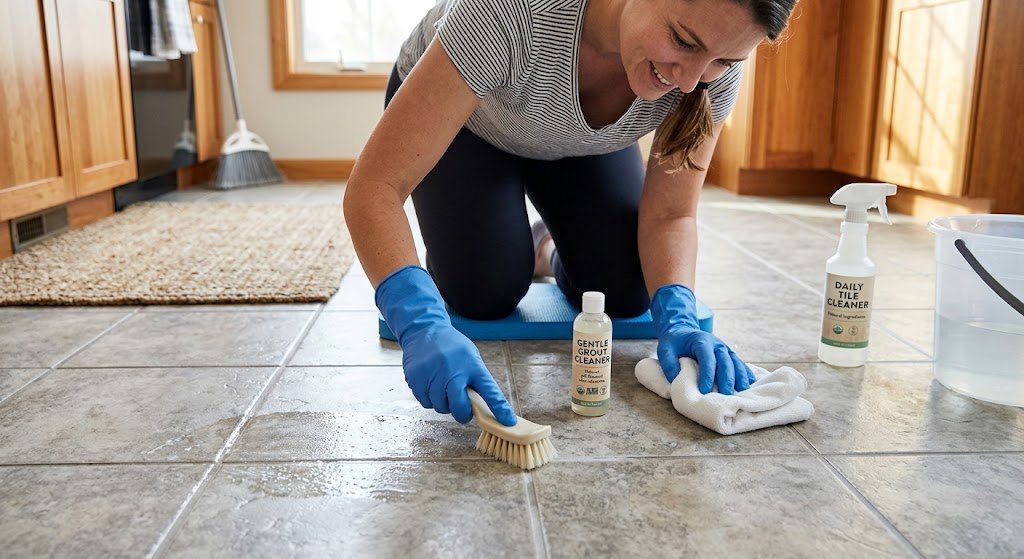
Floor tiles are generally easy to clean, but the grout between them needs a little more care. Strong cleaners, excessive scrubbing and too much water can gradually damage or discolour grout, especially when the wrong cleaning method is used repeatedly.
A good tile-cleaning routine does not need expensive products or harsh chemicals. For many floors, regular dust removal, gentle cleaning and quick attention to spills are enough to keep the surface looking presentable while reducing unnecessary wear on the grout.
The right method depends partly on the type of tile and grout in your home. Ceramic and porcelain tiles can tolerate different cleaning methods from some natural stone surfaces, while older or damaged grout may require extra care.
This guide explains how to clean common tiled floors safely, how to protect the grout and which cleaning habits are better avoided.
Why Grout Needs Different Care From Tiles
Tiles and grout may sit next to each other, but they do not always respond to cleaning in the same way.
Many ceramic and porcelain tiles have relatively non-porous surfaces. Grout, on the other hand, can be more porous and may absorb moisture and dirt.
This means a cleaning product that works well on the tile itself may not necessarily be suitable for the grout.
Aggressive scrubbing can also wear away grout over time, particularly if the grout is already cracked, loose or deteriorating.
The aim is therefore to clean the tile surface while treating the joints between the tiles more gently.
Check What Type of Floor You Have First
Before choosing a cleaner, identify the flooring material if possible.
Common types include:
- Ceramic tile
- Porcelain tile
- Natural stone
- Quarry tile
- Terracotta
- Other specialist tile materials
Ceramic and porcelain floors are common and relatively straightforward to maintain.
Natural stone requires more caution because different stones have different sensitivities to acids and cleaning chemicals.
If you are unsure what material you have, check the manufacturer’s care instructions or any information provided when the floor was installed.
Do not assume that a cleaner labelled as suitable for “tiles” is automatically safe for every type of tile.
Start With Dry Cleaning
One of the simplest ways to protect your floor is to remove loose dirt before using liquid cleaner.
Use a:
- Soft broom
- Microfibre dust mop
- Vacuum cleaner with a suitable hard-floor setting
Sand and grit can act like abrasives when walked across the floor.
If you immediately mop over this material, some of it can be moved across the surface rather than removed.
Regular dry cleaning is especially useful in hallways, kitchens and entrances where outdoor dirt is more likely to enter.
Use a Gentle Cleaning Solution
For many glazed ceramic and porcelain floors, warm water and a suitable mild floor-cleaning product may be enough.
Follow the manufacturer’s instructions for dilution rather than assuming that using more cleaner will produce better results.
Too much cleaning product can leave residue on the floor.
That residue may attract dirt and make the surface appear dull or sticky.
If you are using a new cleaning product, check the label and, where appropriate, test it on a small inconspicuous area first.
Do Not Automatically Use Vinegar on Every Tile Floor
Vinegar is sometimes recommended as a general household cleaner, but it should not be treated as universally safe for tiled floors.
Acidic cleaners can damage or dull some natural stone surfaces, including materials such as marble and limestone.
They may also be unsuitable for certain grout or surface finishes.
If you have natural stone flooring, use a cleaner specifically identified as suitable for that material.
When you do not know what your floor is made from, checking the manufacturer’s guidance is safer than experimenting with acidic cleaners.
Avoid Strong Chemicals Unless They Are Appropriate
More powerful does not necessarily mean better.
Bleach, acids, abrasive powders and other strong products can cause problems if they are unsuitable for the floor or used incorrectly.
Potential issues include:
- Surface damage
- Discolouration
- Grout deterioration
- Residue
- Irritation from fumes or splashes
Always read the product instructions before use.
Never mix household cleaning chemicals unless the manufacturer specifically confirms that they are compatible.
Some combinations can produce dangerous gases.
Mop With Enough Water to Clean, Not So Much That the Floor Stays Wet
Excess water is not helpful simply because tiles are water-resistant.
Water can sit in grout joints, particularly when the floor has uneven areas or damaged grout.
Instead:
- Remove loose dirt first.
- Use an appropriate cleaning solution.
- Mop the floor without flooding it.
- Rinse according to the cleaner’s instructions.
- Remove excess moisture where practical.
- Allow the floor to dry properly.
Good ventilation can help the floor dry more quickly.
This is particularly useful in kitchens, bathrooms and other areas where moisture is already common.
Clean Spills Promptly
A spill is easier to deal with before it dries.
Food, drinks, muddy water and other substances can leave residue if they remain on the floor.
When something spills:
- Pick up solid material first.
- Blot or wipe up the liquid.
- Clean the area with an appropriate product.
- Rinse if the product instructions require it.
- Dry the surface.
Prompt cleaning can reduce the amount of scrubbing needed later.
That matters because aggressive scrubbing can be harder on grout than gentle routine cleaning.
How to Clean Grout Without Scrubbing Too Aggressively
Grout often needs more attention than the tile itself.
For lightly dirty grout, start with a soft brush or an old soft toothbrush and a suitable grout cleaner.
Work on a small section at a time.
Use gentle strokes rather than pressing as hard as possible.
If the dirt does not come away easily, stop and identify what is causing the staining before repeatedly increasing the pressure.
Very old or heavily stained grout may not return to its original colour through ordinary cleaning.
Trying to force it clean with aggressive methods could damage the grout.
Use a Soft Brush for Grout Lines
A soft or medium-soft nylon brush can help reach the textured surface of grout.
Avoid metal brushes.
Metal bristles can scratch nearby surfaces and may damage grout.
A toothbrush can be useful for small areas, while a larger grout brush can make floor maintenance faster.
You do not need to scrub the entire floor aggressively every time you mop.
Regular light cleaning is usually easier on both the floor and your time.
Rinse Away Cleaner Residue
Some cleaning products leave a residue if they are not used or rinsed correctly.
If the product instructions call for rinsing, follow them.
Using excessive amounts of cleaner can make this problem worse.
If your floor feels sticky after cleaning, check whether too much product is being used or whether the cleaning method requires a clean-water rinse.
Always follow the manufacturer’s directions because different products have different requirements.
Pay Attention to the Grout’s Condition
Cleaning will not repair damaged grout.
During routine cleaning, look for:
- Cracks
- Missing sections
- Loose grout
- Dark areas that keep returning
- Areas where grout has become powdery
- Gaps around edges or fixtures
Small areas of damaged grout may need repair rather than more cleaning.
If grout is loose or missing, continued scrubbing can make the problem worse.
If you are unsure whether the damage is cosmetic or could allow moisture to reach the underlying structure, consider getting appropriate professional advice.
Be Careful With Steam Cleaners
Steam cleaning can be useful for some floors, but it should not automatically be considered safe for every tile and grout installation.
Check the tile and grout manufacturer’s guidance before using a steam cleaner.
Consider the condition of the grout as well.
If grout is already damaged or loose, forcing heat and moisture into the area may not be appropriate.
Do not assume that because a machine is marketed for floors it is suitable for every flooring material.
Use Door Mats to Reduce Dirt
Cleaning becomes easier when less dirt reaches the floor.
Place suitable mats near entrances and encourage household members to remove outdoor footwear where practical.
Mats can capture some grit before it reaches the tiled area.
Make sure mats themselves are kept clean.
A dirty mat can eventually become another source of debris.
Protect High-Traffic Areas
Some parts of a tiled floor naturally receive more wear than others.
Hallways, kitchen entrances and areas around sinks can become dirty more quickly.
You may need to clean these areas more often rather than using stronger chemicals.
This is a useful principle:
Increase cleaning frequency before increasing cleaning intensity.
Regular gentle maintenance is generally preferable to allowing heavy dirt to build up and then attacking it with an aggressive cleaner.
Deal With Grease Carefully
Kitchen floors can accumulate grease, particularly around cooking areas.
Plain water may not remove greasy residue effectively.
Use a floor-cleaning product designed for the specific tile material and suitable for grease removal.
Follow the dilution instructions.
Avoid using a highly concentrated product simply because the floor looks particularly dirty.
After cleaning, make sure the surface is not left slippery.
If the product requires rinsing, rinse as directed.
What About White Grout Turning Dark?
Discoloured grout can have several causes.
It might be:
- Surface dirt
- Grease
- Cleaning residue
- Moisture
- Mould or mildew
- Age-related staining
- Damaged or deteriorating grout
The correct treatment depends on the cause.
If the discolouration keeps returning quickly, cleaning alone may not solve the underlying problem.
For example, persistent dampness around a bathroom or poorly ventilated area may need attention.
Do not repeatedly apply stronger chemicals without understanding why the staining is occurring.
Be Careful Around Silicone and Sealants
Tiled areas often contain sealants around:
- Baths
- Shower trays
- Sinks
- Worktops
- Other joints
These materials are different from cement-based grout.
If silicone has become cracked, separated or persistently discoloured, cleaning may not solve the problem.
It may need to be replaced.
If water is getting behind a failed seal, delaying repairs could allow a more serious moisture problem to develop.
How Often Should You Clean Floor Tiles?
There is no single schedule that suits every home.
Cleaning frequency depends on:
- Number of household members
- Pets
- Foot traffic
- Cooking activity
- Outdoor access
- Type of flooring
- Amount of dirt entering the home
A practical routine might involve removing loose dirt regularly and mopping when the floor actually needs it.
High-traffic areas may need more frequent cleaning than bedrooms or less-used rooms.
The objective is to avoid both extremes: allowing dirt to build up for too long or repeatedly using unnecessary cleaning chemicals on an already clean floor.
A Simple Tile-Cleaning Routine
For many suitable tile floors, the process can be kept straightforward.
Step 1: Remove loose dirt
Sweep, dust mop or vacuum the floor.
Step 2: Prepare the cleaner
Use a product appropriate for your tile and grout, following the label instructions.
Step 3: Clean small sections
Mop systematically so that you can see which areas have already been cleaned.
Step 4: Give grout extra attention
Use a suitable soft brush where necessary.
Step 5: Rinse if required
Follow the cleaning product’s instructions.
Step 6: Remove excess water
Avoid leaving puddles sitting on the floor.
Step 7: Allow the floor to dry
Ventilate the room where practical.
This routine is usually more useful than relying on an aggressive cleaning method every few weeks.
Common Tile and Grout Cleaning Mistakes
Using too much cleaner
More product does not necessarily mean a cleaner floor. Excess cleaner can leave residue.
Scrubbing grout too hard
Aggressive brushing can damage already weakened grout.
Flooding the floor
Excess water can remain in grout joints and other areas.
Using acidic cleaners on natural stone
Some natural stones are sensitive to acids.
Mixing cleaning chemicals
Do not mix products unless their manufacturers specifically confirm that they are compatible.
Using abrasive tools
Harsh pads and unsuitable brushes can scratch surfaces or damage grout.
Ignoring damaged grout
Cracks and missing grout require repair rather than increasingly aggressive cleaning.
Cleaning only when the floor looks dirty
Regular light maintenance can reduce the need for heavy cleaning later.
When Should You Consider Professional Help?
Most routine tile cleaning can be handled at home.
However, professional assistance may be appropriate when:
- Large areas of grout are missing
- Tiles are loose or cracked
- Water appears to be getting beneath the floor
- Persistent dampness is present
- Staining keeps returning
- Natural stone requires specialist treatment
- You suspect an underlying leak
- The floor has significant damage
A professional can assess whether the problem is simply surface dirt or whether the flooring system needs repair.
Frequently Asked Questions
Can I use vinegar to clean floor tiles and grout?
It depends on the flooring materials. Vinegar is acidic and should not automatically be used on every tile or grout installation. It can damage or dull some natural stone surfaces, including acid-sensitive stones. Check the manufacturer’s care instructions and use a cleaner specifically suitable for your flooring when in doubt.
How can I clean grout without damaging it?
Start with a suitable grout cleaner and a soft or medium-soft brush. Work gently rather than applying excessive pressure. Avoid metal brushes and highly abrasive tools. If grout is already cracked, loose or missing, cleaning will not repair it and aggressive scrubbing may make the damage worse.
How often should I mop tiled floors?
The right frequency depends on how quickly the floor becomes dirty. High-traffic areas may need more frequent cleaning than rooms that are rarely used. Rather than following a rigid schedule, remove loose dirt regularly and mop when the surface needs it. Regular light cleaning can reduce the need for aggressive deep cleaning.
Why does my grout keep getting dirty?
Grout can collect dirt because it may be more textured and porous than the surrounding tile. Persistent discolouration can also be linked to moisture, grease, cleaning residue or mould. If the same area repeatedly becomes dark shortly after cleaning, investigate the underlying cause rather than simply using stronger cleaning products.
Can I use bleach on grout?
Bleach should not be treated as a universal grout cleaner. Whether it is appropriate depends on the grout, surrounding materials and the manufacturer’s instructions. Incorrect use can cause discolouration or other damage. If you use any chemical cleaner, follow its label instructions carefully and never mix bleach with other cleaning products.
Is steam cleaning safe for tiled floors?
It depends on the tile, grout and condition of the installation. Some flooring manufacturers allow steam cleaning, while others recommend different methods. Check the manufacturer’s instructions before using a steam cleaner. Be particularly cautious if the grout is damaged, loose or deteriorating.
How can I keep floor grout cleaner for longer?
Regularly remove loose dirt, clean spills promptly and avoid allowing heavy grime to build up. Use suitable cleaning products rather than excessive amounts of strong chemicals. Mats near entrances can also reduce the amount of grit entering the room. If grout repeatedly becomes dirty or damp, investigate whether there is an underlying moisture or ventilation problem.
Final Thoughts
Keeping floor tiles clean does not require aggressive chemicals or constant scrubbing.
The most useful approach is usually simple: remove loose dirt regularly, clean spills promptly, use a product suitable for your particular flooring and give grout gentle attention when needed.
Avoid assuming that every tile can be cleaned in exactly the same way. Natural stone, older grout and specialist finishes may require different care. If you are uncertain, manufacturer’s instructions are a better starting point than a generic cleaning tip.
Pay attention to the condition of the grout as well. Cracks, missing sections, persistent dampness and recurring stains can indicate that the problem goes beyond ordinary dirt.
With regular, gentle maintenance, you can keep a tiled floor looking cleaner while reducing unnecessary wear on the grout.