
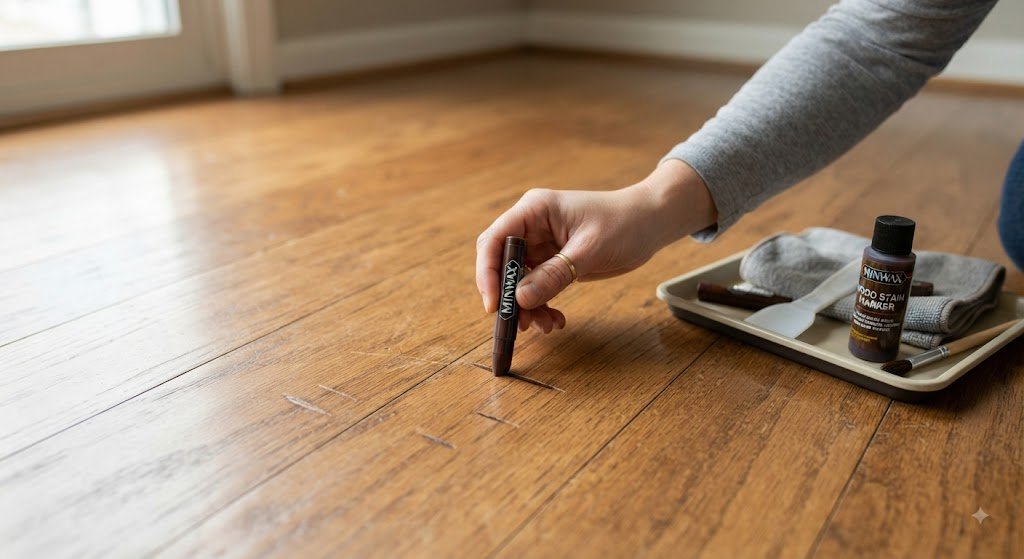
A small scratch on the floor can be easy to ignore until sunlight hits it from the right angle. Suddenly, the mark seems much more obvious.
Scratches often appear around dining tables, office chairs, doorways, furniture legs, and busy walking areas. Sometimes the damage is barely more than a surface mark. Other times, the scratch has cut through the protective finish or decorative layer.
The important thing is to identify what kind of flooring you have and how serious the damage actually is before trying to repair it.
A method that is reasonable for solid wood can damage laminate. A product made for vinyl may not be suitable for natural stone. Even two floors made from similar materials can have different finishes that require different care.
This guide explains how to inspect a small floor scratch, distinguish scratches from scuffs and chips, and choose a sensible repair approach for several common flooring materials.
Before You Repair the Scratch, Identify the Flooring
Start with the flooring itself.
Look at the manufacturer’s information if you still have it. Check old installation documents, product packaging, spare flooring, or the manufacturer’s website if you know the product name.
If you don’t know exactly what the floor is, look closely at the pattern and construction.
A few common possibilities include:
- solid hardwood
- engineered wood
- laminate
- vinyl plank or tile
- sheet vinyl
- ceramic tile
- porcelain tile
- natural stone
- cork
This matters because the visible surface of each material behaves differently.
For example, sanding can be appropriate for some solid wood floors but can permanently damage the decorative layer of laminate.
First Determine Whether It Is Actually a Scratch
Not every mark on a floor is a scratch.
A black or gray line from a chair leg may be a rubber transfer. A dull patch may be residue. A mark from a shoe may disappear with suitable cleaning.
Before using a repair product, clean the area using a method recommended for your flooring.
Then inspect it again.
If the mark disappears, you may not need a repair at all.
If it remains, run a clean fingertip gently across the surface.
If you can barely feel anything, the damage may be limited to the finish.
If your fingernail catches in the groove, the damage is deeper and may have penetrated the finish or decorative surface.
Don’t use your fingernail as a scientific measurement. It is simply a quick way to distinguish a mostly visual mark from a groove you can actually feel.
Look at the Color Inside the Scratch
The appearance of the damaged area can provide another clue.
If the scratch is the same color as the surrounding floor and is mainly visible because of changed sheen, it may be affecting the finish.
If you can see a lighter, darker, or completely different material underneath, the scratch may have gone deeper.
For laminate, a deep scratch can expose the decorative layer or underlying material.
For wood, it may expose unfinished wood.
For vinyl, it may penetrate the wear layer.
For tile, what looks like a scratch may actually be a chip in the glaze.
The repair method should match the actual damage.
How to Fix Small Scratches on Laminate Flooring
Laminate flooring usually has a decorative printed layer protected by a wear layer. It is not simply a thin piece of hardwood.
That makes aggressive sanding a poor choice for most laminate scratches.
Start With a Careful Cleaning
Clean the area using a laminate-safe product and a suitable cloth or mop.
Don’t flood the floor.
Excess moisture can enter joints and contribute to swelling, especially if the flooring or its joints are already damaged.
Once the area is clean and dry, inspect the mark again.
For a Very Light Scratch
If the mark is shallow and the decorative surface is still intact, a laminate repair product may be enough to make it less noticeable.
Repair kits can contain products such as colored wax or putty designed for small surface damage.
Choose a color that closely matches the floor.
Don’t apply a large amount immediately.
Test the product as directed, ideally in an inconspicuous location when possible.
Then fill or touch up the damaged area according to the product instructions.
Remove excess material carefully so you don’t leave a raised patch.
For a Deep Laminate Scratch
If the decorative layer is badly damaged, the repair may remain visible even after using a color-matched product.
If the plank is swollen, chipped, cracked, or otherwise damaged beyond a small surface mark, replacement may produce a better result.
This is particularly true when spare matching planks are available.
Do not sand through the top surface in an attempt to make the scratch disappear.
You can turn a small repair into permanent damage to the plank.
How to Fix Small Scratches on Solid Wood Flooring
Solid wood gives you more repair options than laminate because the material extends below the surface.
However, that doesn’t mean every scratch should be sanded.
First determine whether the scratch is mainly in the finish or has reached the wood.
Light Scratches in the Finish
If the wood itself is not exposed, start with the least aggressive approach.
Clean the floor using a product suitable for its finish.
Some floors may have a finish that can be refreshed using a compatible maintenance product. Others may require a different approach.
Don’t automatically apply furniture polish, oil, wax, or another household product.
The wrong product can change the floor’s sheen or interfere with future refinishing.
Scratches That Expose the Wood
A deeper scratch may reveal unfinished wood.
For a small localized mark, a color-matched touch-up product can sometimes reduce the contrast.
Depending on the finish and flooring system, a suitable wood repair stick, filler, or touch-up product may be appropriate.
The color does not need to be perfect while you’re choosing it. Test carefully because a repair that is too dark can be more noticeable than the original scratch.
When Sanding Makes Sense
Sanding can be useful for some solid wood floors when scratches extend into the finish or wood.
But localized sanding is not risk-free.
If you remove too much material from one small area, you can create a visible depression or a patch that reflects light differently from the rest of the floor.
If the floor has extensive scratches, a specialty finish, or significant damage, professional refinishing may be a better option.
How to Fix Scratches on Engineered Wood Flooring
Engineered wood has a real wood surface over a layered core.
The thickness of the top wood layer can vary between products.
That difference matters if you’re considering sanding.
A floor with a thicker wear layer may have different refinishing possibilities from one with a very thin top layer.
For Shallow Scratches
Start with suitable cleaning.
If the scratch affects only the finish, use a repair or maintenance product that is compatible with that finish.
A color-matched touch-up product may also help with a small visible mark.
For Deeper Scratches
If the scratch exposes the underlying layer, don’t assume it can simply be sanded away.
Check the manufacturer’s information before removing material from the surface.
If you cannot determine the thickness of the top wood layer, avoid experimenting with aggressive sanding.
For deep gouges or damage across several boards, professional advice can help you determine whether repair or replacement makes more sense.
How to Fix Small Scratches on Vinyl Flooring
Vinyl flooring can be made as planks, tiles, or sheets, and its surface may imitate wood, stone, or other materials.
The exact construction varies, so check the manufacturer’s care instructions when possible.
Start With a Gentle Cleaning
Clean the area using a vinyl-safe cleaner.
Avoid rough scouring pads and abrasive powders.
Something that seems like a harmless cleaning attempt can dull the surrounding surface and make the original scratch even more noticeable.
For Small Surface Scratches
A vinyl repair product designed for the particular flooring can sometimes reduce the appearance of a deeper mark.
Follow the product instructions carefully.
If possible, test it somewhere inconspicuous before applying it to the visible area.
For Cuts or Torn Vinyl
A cut is different from a shallow scratch.
If the vinyl has been cut through, torn, or lifted, repeatedly applying a surface treatment may not produce a durable or attractive repair.
Depending on the flooring type, replacing a damaged plank or tile may be easier.
Sheet vinyl can require a more involved repair because the damaged section is part of a continuous floor.
How to Fix Scratches on Ceramic and Porcelain Tile
Tile requires a different approach from wood and resilient flooring.
First clean the tile so you can see what you are dealing with.
A mark on the surface may actually be metal transfer, dirt, or another deposit rather than damage to the tile itself.
If the Glaze Is Intact
If the mark does not appear to penetrate the glazed surface, avoid abrasive tools.
Trying to scrub away a tiny mark with an aggressive pad can create a dull area that is more noticeable than the original problem.
Use a cleaning method appropriate for the tile.
If the Tile Is Chipped
A chipped glaze is not the same as a simple surface scratch.
A suitable tile repair product may disguise a small chip, but it may remain visible from certain angles.
If the tile is cracked, badly chipped, or structurally damaged, replacement may be a better solution.
Do not assume that polishing or sanding a glazed tile will produce the same result as repairing a wood floor.
How to Fix Scratches on Natural Stone Flooring
Natural stone needs particular care because different stones and finishes behave differently.
Marble, travertine, limestone, slate, and other stones should not automatically be treated with the same cleaning or repair method.
Identify the Stone First
If possible, determine what type of stone you have.
Also consider whether the surface is:
- polished
- honed
- textured
- sealed
- otherwise treated
A scratch in a polished surface may actually be a change in the finish rather than a simple groove in the stone.
Avoid Random Household Cleaners
Don’t experiment with acidic or strongly abrasive products.
Some natural stones can react to acids, while abrasive products can alter the surface appearance.
For a valuable or heavily damaged stone floor, professional stone restoration may be safer than trying several internet remedies.
How to Fix Scratches on Cork Flooring
Cork is softer than many hard flooring materials and can show marks from furniture and footwear.
Begin with cleaning using a product suitable for the floor’s finish.
For a small scratch, a manufacturer-approved touch-up product may improve the appearance.
Don’t assume that sanding is automatically safe.
Cork floors can vary in thickness and finish, so removing material without knowing the construction can create a larger damaged area.
How Deep Is Too Deep for a Simple Touch-Up?
There is no single depth measurement that applies to every type of flooring.
Instead, look at what the scratch has damaged.
Mostly visual mark
If you cannot feel much of a groove and the protective or decorative surface appears intact, start with cleaning and a compatible maintenance method.
Scratch you can feel
If your fingernail catches, inspect the damaged area closely. A suitable repair product may be needed.
Different material visible
If the scratch exposes another color or layer, the damage has likely gone beyond a superficial mark.
Choose a repair method designed for that material.
Broken, swollen, cracked, or torn flooring
This is no longer just a small cosmetic scratch.
Repair or replacement may be necessary.
What Not to Do When Repairing Floor Scratches
Don’t Sand Laminate Just Because It Works on Wood
Laminate’s surface is constructed differently from solid wood.
Sanding can remove the decorative or protective layer.
Once that happens, the damage may be impossible to hide properly.
Don’t Use Abrasive Cleaners on Every Floor
A product that works on one material can dull another.
Always consider the flooring type before using abrasive cleaning products.
Don’t Use a Permanent Marker Without Testing
A marker can seem like an easy way to hide a scratch.
The color may look completely different once it is applied to the floor.
It can also spread beyond the damaged area.
If a touch-up product is needed, use one intended for the flooring whenever possible.
Don’t Flood the Floor
Water is particularly risky around flooring joints and damaged areas.
Use the smallest amount of moisture appropriate for the cleaning method.
Don’t Keep Adding Repair Product
If one application doesn’t look right, adding more material may create a raised or discolored patch.
Let the product set as instructed and evaluate the result before doing anything else.
How to Make a Floor Scratch Less Noticeable
Not every repair needs to make the damage completely invisible.
The goal is usually to restore a reasonable appearance without creating a larger problem.
Clean the area first.
Match the repair material carefully.
Apply small amounts.
Remove excess material.
Allow it to cure or dry as directed.
Then inspect the repair under the same lighting in which the scratch was originally noticeable.
A repair that looks perfect from one angle may still be visible from another.
That doesn’t necessarily mean it failed.
How to Prevent New Scratches
Once you’ve repaired a scratch, try to identify what caused it.
If a chair created the damage, check its feet.
If grit is being dragged inside, improve entryway cleaning.
If furniture is being moved frequently, change how it is moved.
Use suitable protective pads beneath furniture legs.
Lift furniture when practical instead of dragging it.
Keep sand and grit from building up on the floor.
Use mats in areas where outdoor debris is regularly brought inside.
Choose cleaning tools recommended for the flooring.
For chairs that move constantly, make sure the casters or feet are suitable for the floor rather than assuming all furniture hardware is safe for every surface.
When Scratches Keep Appearing in the Same Area
Repeated scratches can tell you something useful.
If a particular spot keeps getting damaged, repairing the floor without fixing the cause is only temporary.
Check nearby furniture.
Look for rough chair feet, exposed screws, damaged casters, grit trapped underneath furniture, or an object that repeatedly contacts the floor.
The solution may be as simple as replacing a worn furniture pad.
When DIY Repair Is Not the Best Option
A small cosmetic scratch is usually a reasonable DIY project when the flooring is otherwise sound.
Consider professional help when:
- a wood floor has a deep gouge
- several boards are heavily damaged
- engineered wood may require sanding
- laminate is swollen or badly chipped
- vinyl is torn
- a tile is cracked
- natural stone has significant surface damage
- the flooring is expensive or difficult to replace
- you cannot identify the material or finish
- repeated repairs keep failing
The more valuable or difficult the floor is to replace, the more sense it can make to get advice before experimenting.
A Simple Scratch-Repair Decision Guide
Use this sequence before reaching for a repair product.
Does the mark disappear after suitable cleaning?
If yes, it may have been a scuff or surface deposit rather than a scratch.
Is the mark still visible but difficult to feel?
Start with a flooring-appropriate maintenance or touch-up approach.
Does your fingernail catch in the groove?
Inspect the damage more closely and choose a repair product designed for that flooring.
Is another layer or color visible?
The scratch has likely penetrated the surface. Use a material-specific repair method.
Is the floor cracked, swollen, torn, or badly chipped?
A simple touch-up may not be enough. Consider repair or replacement.
Does the same area keep getting scratched?
Find and remove the source of the damage.
Frequently Asked Questions
Can I remove floor scratches with toothpaste?
It is better not to use toothpaste as a general floor-repair method. Toothpaste contains mild abrasives, and different flooring finishes can react differently to abrasive products. A product designed for your flooring is a safer choice.
Can I use a magic eraser on a scratched floor?
Use caution. Melamine cleaning sponges can be abrasive and may change the sheen of some flooring. If the flooring manufacturer does not recommend them, choose a gentler cleaning method.
Can I sand scratches out of laminate flooring?
Generally, sanding is not a good DIY solution for laminate. The visible surface contains a decorative layer protected by a wear layer, and sanding can permanently damage it.
Can small scratches be repaired on hardwood?
Often, yes. The appropriate method depends on whether the scratch affects only the finish or extends into the wood. Small marks may respond to a compatible touch-up product, while deeper damage may require more extensive refinishing.
How do I repair a scratch in vinyl flooring?
Start with suitable cleaning and inspect the depth of the damage. A compatible vinyl repair product may help with a small scratch. If the surface is cut or torn, replacing the affected plank or tile may provide a better result.
Can scratched ceramic tile be repaired?
It depends on whether the tile is actually scratched, stained, or chipped. A small chip can sometimes be disguised with an appropriate repair product, while a cracked or badly damaged tile may need replacement.
How do I stop furniture from scratching my floor?
Use suitable protective pads or floor-safe feet under furniture, keep grit away from the floor, and avoid dragging heavy furniture across the surface. For frequently moved chairs, check that the feet or casters are appropriate for your flooring.
Should I replace a floor because of a few scratches?
Usually not. A few small cosmetic scratches rarely justify replacing an otherwise sound floor. Replacement becomes more reasonable when the material is cracked, swollen, torn, badly chipped, or too extensively damaged to repair acceptably.
Why do my floor scratches keep coming back?
Something may be causing repeated damage. Check furniture feet, chair casters, grit, cleaning tools, and objects that are frequently dragged across the floor. Repairing the scratch without fixing the cause can lead to the same problem again.
Final Thoughts
A small floor scratch does not automatically mean the flooring needs to be replaced.
The first step is to identify what you are actually looking at. Clean the mark, inspect it closely, determine whether you can feel a groove, and check whether the damage has exposed another layer.
Then choose a repair method that matches the flooring.
Laminate usually needs a different approach from solid wood. Engineered wood needs special consideration before sanding. Vinyl can be damaged by aggressive cleaning, while tile and natural stone require their own care.
When you’re unsure, start with the least aggressive method. A careful repair that slightly reduces the appearance of a scratch is usually better than an experiment that damages the surrounding finish.
And if the same area keeps getting scratched, look beyond the mark itself. The most useful repair may be fixing the chair, furniture, cleaning method, or other source that caused the damage in the first place.