
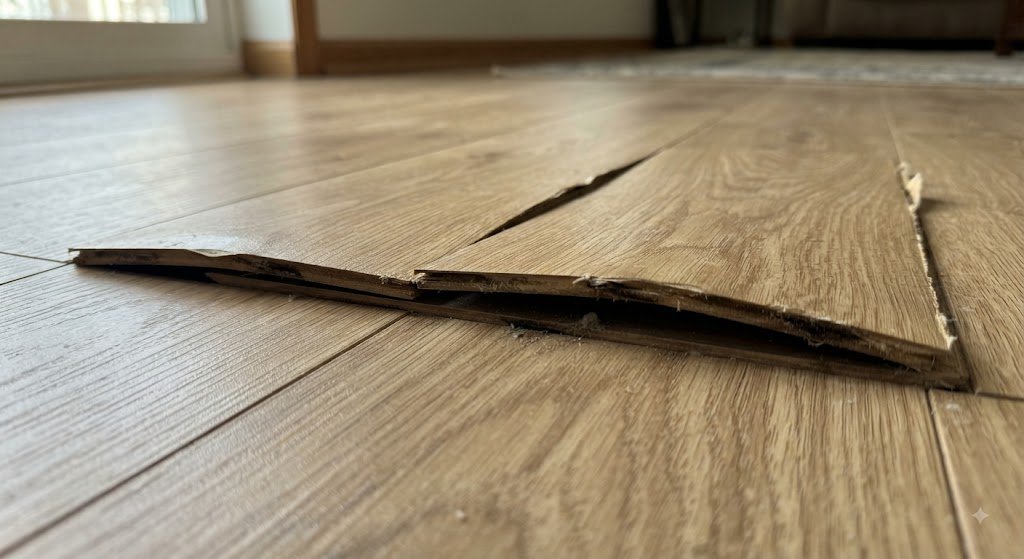
Laminate flooring is designed to create a smooth, stable surface, so raised edges can be a sign that something has changed underneath or around the floor. You may notice one board curling upward, a raised seam between planks, or several boards beginning to lift near a wall.
The cause is not always the same. Moisture, insufficient expansion space, installation problems, uneven subfloors, or damage to the locking system can all contribute. Finding the cause matters because simply pressing the flooring back down may only hide the problem temporarily.
A small isolated area can sometimes be corrected with a straightforward repair. If the lifting is widespread, keeps returning, or is connected to moisture damage, the floor may need a more careful inspection.
What Edge Lifting in Laminate Flooring Means
Laminate flooring is made from several layers, with a decorative surface over a core material. Many laminate floors use click-lock edges that connect individual planks.
Unlike some flooring materials, laminate generally needs room to expand and contract as indoor conditions change. The floor is normally installed with a small perimeter gap that is covered by trim.
When the flooring cannot move as intended, pressure can build between planks. This may cause joints to rise, boards to separate, or edges to lift.
A raised edge can also result from moisture affecting the core of the laminate. Once the material has swollen or changed shape, simply pushing it flat may not restore its original condition.
Common Reasons Laminate Flooring Lifts at the Edges
Moisture getting into the flooring
Moisture is one of the first things worth checking.
Laminate flooring can be affected by spills, leaks, wet cleaning methods, plumbing problems, or moisture coming from below. Water can enter through damaged seams or exposed edges.
In a kitchen, bathroom-adjacent area, laundry space, or entryway, consider whether the floor has been exposed to water recently.
Look for swelling, discoloration, soft spots, damaged seams, or a musty smell. These signs do not prove the exact source, but they can indicate that moisture deserves investigation.
Not enough expansion space
Laminate flooring needs room to accommodate normal changes in temperature and humidity.
If planks were installed too tightly against walls, cabinets, door frames, or other fixed objects, the floor may have nowhere to move.
As the flooring expands, pressure can build and cause sections to rise.
This is particularly likely when lifting appears near the perimeter of a room or after a period of increased humidity.
Installation problems
A laminate floor can lift if the installation was not carried out according to the flooring manufacturer’s requirements.
Possible problems include an unsuitable underlayment, incorrect locking of planks, insufficient expansion gaps, or installation over a surface that was not adequately prepared.
If the flooring was installed recently and lifting has appeared in multiple locations, review the installation instructions and consider contacting the installer or flooring supplier.
Uneven subfloor
Laminate needs a reasonably suitable surface underneath it.
If the subfloor has high or low areas, the laminate may flex when people walk across it. Repeated movement can put stress on the locking joints.
An uneven surface can sometimes be felt as a soft or bouncy area rather than seen immediately.
If several planks appear to rise in the same area, investigate the floor beneath them rather than assuming the laminate itself is defective.
Heavy objects restricting movement
Large fixed objects can sometimes prevent floating laminate flooring from moving naturally.
Kitchen cabinets, built-in furniture, partitions, and other permanent structures need to be considered during installation.
If the flooring was installed around a fixed object without allowing appropriate movement, pressure can build over time.
Damaged locking joints
Click-lock laminate depends on the edges of the boards fitting together correctly.
A damaged joint may prevent planks from sitting flat. This can happen during installation, removal, or later movement.
If the lifting is concentrated around one damaged plank or joint, replacing the affected boards may be more practical than trying to force them back together.
What You Should Check First
Before attempting a repair, identify where the lifting starts.
Look at the floor from a low angle so you can see raised seams more clearly. Walk carefully across the area and notice whether it feels firm or unusually springy.
Then check the perimeter of the room. If the flooring is pressing tightly against walls or trim, lack of expansion space may be contributing to the problem.
Look for obvious signs of water exposure as well.
Ask yourself:
- Did the lifting appear after a spill or leak?
- Is the damage close to a plumbing fixture?
- Are only one or two planks affected?
- Are several boards rising together?
- Does the floor feel uneven underneath?
- Is the laminate pressed tightly against a wall or fixed object?
- Does the surface show swelling or damaged edges?
These observations can help you decide whether the issue is likely to be localized or more widespread.
Check for Moisture Before Doing Anything Else
If moisture may be involved, address the source first.
A visible spill is relatively simple to deal with, but hidden moisture can come from leaking plumbing, appliances, doors, windows, or the subfloor.
Do not cover a damp area with trim or attempt to force swollen boards flat.
Allowing the area to dry may be enough when the flooring has only experienced a minor surface spill and has not been permanently damaged. However, laminate that has swollen, warped, or separated may need replacement.
[Internal link opportunity: article about finding small signs of water damage before they become expensive repairs]
How to Deal With a Small Raised Edge
The appropriate repair depends on the cause.
If the flooring is otherwise intact and the problem is related to a small obstruction or insufficient clearance, the affected section may be able to move back into position after the restriction is corrected.
First remove the trim carefully enough to inspect the perimeter. Do not force the boards while the trim is still holding them tightly.
Check whether there is a suitable gap between the flooring and the wall. The required clearance varies by flooring product, room conditions, and installation instructions, so follow the manufacturer’s specifications rather than guessing.
If the floor is swollen from water, increasing the expansion gap will not restore the damaged board. Swollen laminate may need to be replaced.
How to Replace a Damaged Laminate Plank
If one or more boards have been permanently damaged, replacement may be possible without removing the entire floor.
The exact method depends on the laminate’s locking system and where the damaged plank is located.
1. Find a matching replacement
Ideally, use spare boards from the original installation.
If no spare flooring is available, try to identify the original product. Keep in mind that an older floor may have changed slightly in appearance because of normal wear and exposure to sunlight.
2. Remove the surrounding trim if necessary
Trim may need to be removed to access the flooring.
Work carefully because trim can crack or its fasteners can damage the wall if removed aggressively.
3. Disassemble the flooring when possible
Many click-lock systems can be taken apart from the nearest wall by lifting and releasing the boards according to the manufacturer’s installation method.
Do not force a locking joint. Some systems are designed for repeated assembly and disassembly, while others can be damaged if handled incorrectly.
4. Replace the damaged board
Once the affected plank is accessible, install the replacement using the correct locking method.
Make sure the new board sits at the same height as the surrounding flooring and that the joints are properly engaged.
5. Reinstall the trim
After checking the flooring, reinstall suitable trim without pinning the floating floor tightly against the wall.
The trim should conceal the required expansion gap while allowing the floor to move as designed.
What If the Floor Is Lifting in the Middle of the Room?
Lifting in the middle of a room deserves more attention than a small edge problem.
A central raised area may indicate that the floor has expanded and become trapped, particularly if there is insufficient perimeter clearance.
It could also be related to moisture, an uneven subfloor, damaged locking joints, or an obstruction underneath the flooring.
Do not simply place heavy furniture on the raised section to flatten it. Extra weight can damage the locking system or make the underlying problem harder to identify.
If the raised area is large or continues to worsen, consider having the installation inspected.
Common Mistakes to Avoid
Forcing the boards flat
Pushing hard on a raised plank may damage the locking mechanism or break the board.
Find out why it is lifting first.
Using glue without checking the flooring system
Floating laminate is generally designed to move independently rather than being permanently bonded to the subfloor.
Adding glue in the wrong location can interfere with the floor’s intended movement.
Ignoring moisture
If water caused the problem, pressing the laminate flat will not solve the source.
Check for leaks and allow appropriate drying or replace damaged material when necessary.
Removing too much flooring
Do not dismantle large sections before determining where the problem begins.
A careful inspection can help you avoid unnecessary work.
Installing over an uneven surface
If the subfloor is causing movement, replacing the visible laminate without correcting the underlying surface may result in another failure.
When You Should Call a Professional
Professional help is sensible when the cause is unclear or the damage is widespread.
Consider getting an inspection if several areas are lifting, the subfloor appears damaged, there is persistent moisture, or the floor has become significantly uneven.
You should also seek help if water has entered beneath a large section of flooring and you are unsure whether the subfloor has been affected.
If the laminate is installed in a rental property, report significant lifting or suspected water damage to the property manager before removing flooring.
A flooring professional can also help when the original installation has complicated clearance issues around cabinets, door frames, partitions, or other fixed structures.
How to Prevent Laminate Flooring From Lifting
Follow the flooring manufacturer’s installation requirements from the beginning.
The subfloor should be appropriately prepared, and the recommended underlayment and expansion clearances should be used.
Keep water exposure under control. Clean spills promptly and avoid leaving excessive water on the floor during routine cleaning.
Pay attention to areas near appliances and plumbing connections. A small leak can cause flooring problems before it becomes obvious.
Avoid trapping a floating floor under fixed structures unless the installation system specifically allows it.
Finally, investigate small changes early. A slight raised seam can be much easier to correct before several boards become affected.
Frequently Asked Questions
Can I push lifted laminate flooring back down?
You can gently assess whether the flooring moves back into position, but do not force it. If something is preventing the floor from moving or the board has swollen, pressing it down may cause additional damage.
Does water always ruin laminate flooring?
No. A brief surface spill does not automatically mean the floor must be replaced. The outcome depends on how much moisture reached the flooring, how quickly it was removed, and whether the boards or underlying materials were damaged.
Why is my laminate floor lifting near the wall?
Insufficient expansion clearance is one possible cause. The floor may be pressing against the wall or another fixed object as it expands. Moisture or installation problems can also produce similar symptoms.
Can I fix swollen laminate flooring?
If a laminate plank has visibly swollen or permanently changed shape, it usually cannot simply be flattened back to its original condition. The affected plank may need replacement after the moisture source has been addressed.
Should I glue down lifted laminate flooring?
Do not glue a floating laminate floor down unless the flooring manufacturer specifically requires or permits that installation method. Glue can prevent the flooring from moving as designed.
Why does laminate flooring lift months after installation?
The problem may develop after installation because of changes in humidity, moisture exposure, seasonal movement, installation restrictions, or a problem with the subfloor. A delayed problem does not necessarily mean the flooring itself was defective.
Final Thoughts
Laminate flooring that lifts at the edges is usually giving you a clue that something is restricting, moving, or affecting the flooring.
Moisture and insufficient expansion space are two important things to investigate, but uneven subfloors, installation problems, damaged locking joints, and fixed obstructions can also play a role.
Do not start by forcing the boards flat. First inspect the affected area, check for moisture, look at the perimeter, and compare the problem area with nearby flooring.
If the damage is limited and the boards are otherwise sound, a careful adjustment or plank replacement may be possible. If several areas are lifting or the subfloor or moisture is involved, finding the underlying cause is more important than making the surface look flat temporarily.