
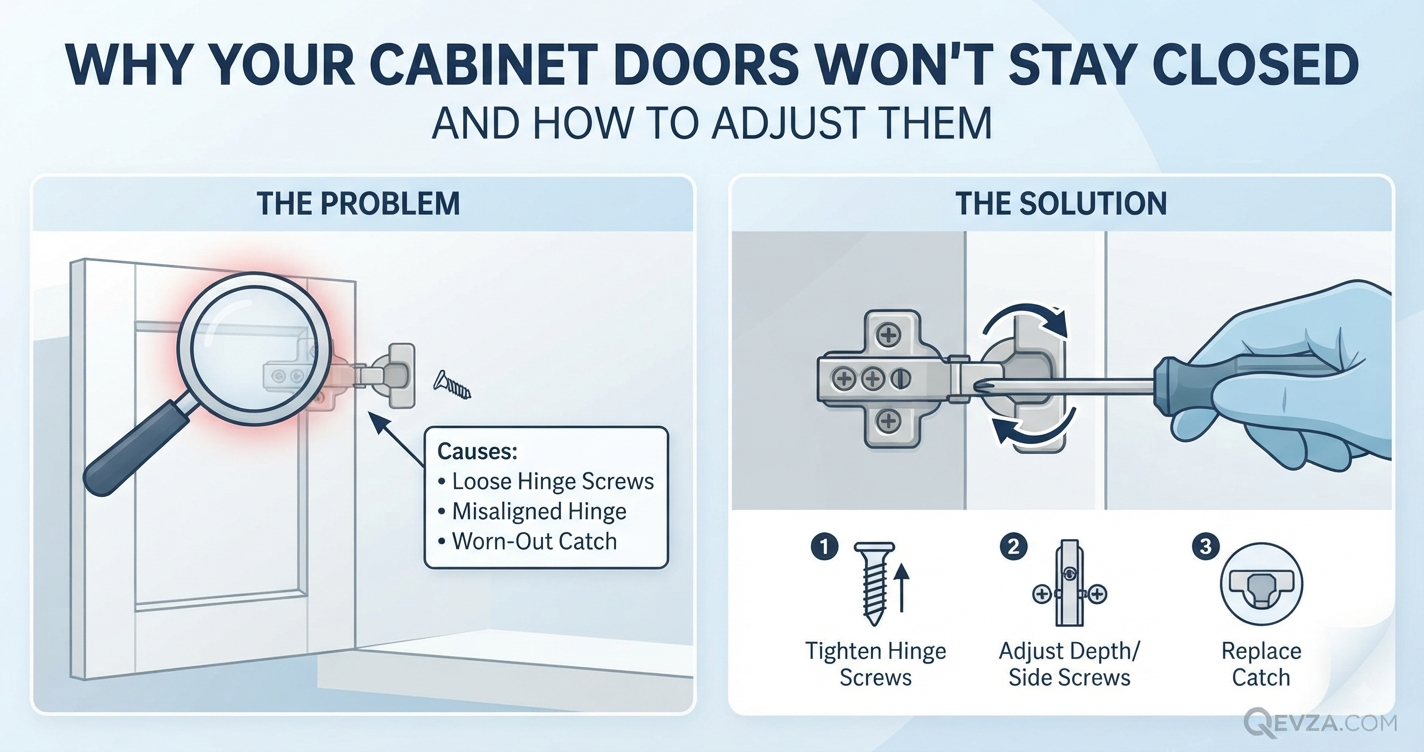
You walk into the kitchen, and a cupboard door stands stubbornly ajar, exposing mismatched mugs or boxes of cereal. You push it shut, but within a few seconds, it drifts back open on its own.
It is a minor daily annoyance that can make an otherwise tidy kitchen look messy. Many people assume that changing weather has warped the wood or that the entire cabinet box has shifted out of square.
Most of the time, however, the culprit is simply a loose hinge or a worn-out magnetic catch. Modern European hinges and traditional hardware are designed with built-in adjustment screws that let you correct these alignment issues in minutes using a simple screwdriver.
What the Problem Usually Means
When cabinet doors refuse to stay shut, it indicates a breakdown in how the door interacts with the cabinet face frame or the internal magnetic hardware.
Cabinet doors rely on a delicate balance of tension and geometry. If a hinge slips, the door hangs crookedly, preventing the magnetic catch from making full contact. Alternatively, if the hinges are adjusted too tightly, they can act like tiny springs, pushing the door back open the moment your hand lets go.
Identifying whether your doors are bouncing back from tension or simply missing their magnetic closures points you directly to the right adjustment.
Common Reasons This Happens
Kitchen cabinets endure heavy daily use, from slamming doors during hurried meal preps to constant vibrations from nearby appliances.
-
Hinge adjustment screws have drifted: Modern concealed hinges feature multiple adjustment screws. Over months of opening and closing, vibrations cause these screws to turn slightly, shifting the door out of alignment.
-
Loose mounting plates: The screws holding the hinge plate to the inside wall of the cabinet box can back out, allowing the entire door assembly to sag.
-
Worn or misaligned magnetic catches: On older cabinets or face-frame styles, a small magnetic catch or roller catch holds the door shut. If the metal plate on the door no longer aligns flush with the magnet, the magnetic pull is lost.
-
Warped door panels: Solid wood doors can warp slightly when exposed to heavy steam from a dishwasher or high seasonal humidity changes, preventing them from seating flat against the frame.
What You Can Check Yourself
Before you touch any tools, take a close look at how the cabinet door rests against the frame when it is supposedly “closed.”
-
Check the gap around the door: Look at the vertical and horizontal gaps between the door and the cabinet frame. If the gap is wider at the top than the bottom, or if the edge of the door rubs against the frame, your hinges have shifted.
-
Inspect the magnetic contact: Open and close the door slowly while watching the magnetic catch. Does the metal plate on the door touch the magnet squarely, or does it hit at an angle or miss entirely?
-
Test for tension: If the door swings open immediately after you push it closed, the hinge arms may be fighting each other due to improper depth adjustment.
[Internal link opportunity: article about essential tools every homeowner should keep in a basic toolkit]
How to Fix the Problem
Most cabinet door issues can be resolved depending on the type of hardware your kitchen features.
Adjusting Modern Concealed Hinges
If your cabinets were installed within the last couple of decades, they likely use adjustable European cup hinges. These hinges typically have up to three adjustment screws:
-
Side-to-side adjustment (the front screw): Turning this screw moves the door left or right, correcting uneven gaps between double doors.
-
Depth adjustment (the middle screw or spiral arm): Turning this screw moves the entire door closer to or further away from the cabinet box. If your door won’t stay closed, it may be sitting too far forward, creating tension that pushes it open. Turn this screw slightly to allow the door to rest flush.
-
Height adjustment (the mounting plate screws): Loosening the screws on the mounting plate attached to the cabinet wall allows you to slide the whole door up or down if it is dragging on the bottom shelf.
Fixing Magnetic Catches and Roller Catches
If your cabinets use traditional exposed hinges and a magnetic catch at the top or bottom:
-
Loosen the screws on the magnetic catch plate attached to the cabinet frame slightly.
-
Place a small dab of toothpaste or chalk on the face of the magnet.
-
Close the door firmly so the magnet leaves a mark on the metal door plate.
-
Adjust the metal plate on the door so it aligns precisely with the chalk mark, then tighten the screws securely.
What to Do If Screws Won’t Hold
Constant use can strip out the small particle board or soft wood holes where cabinet hinges mount to the frame. If a hinge screw spins freely without tightening, you need to rebuild the anchor point.
-
Remove the hinge screws and pull the hinge away from the cabinet wall.
-
Insert a standard wooden toothpick coated in wood glue into the stripped screw hole.
-
Snap off any excess wood flush with the surface.
-
Reattach the hinge and drive the screw back into the newly reinforced hole, where it will grip the fresh wood fibers firmly.
[Internal link opportunity: article about fixing stripped screw holes in wood doors]
Common Mistakes to Avoid
-
Adjusting all three screws at once: When tweaking concealed hinges, turn only one screw at a time and test the door. Changing multiple variables at once makes it difficult to track what corrected the issue.
-
Using a power drill for adjustments: Never use a power drill or impact driver on delicate cabinet hinge screws. Hand-turn them with a standard manual screwdriver to maintain complete control over torque and prevent stripped heads.
-
Slamming misaligned doors: Forcing a stubborn cabinet door shut bends the hinge arms and damages the surrounding wood face frame. Address the alignment rather than fighting the hardware.
When You Should Call a Professional
While cabinet hinge adjustments are classic DIY territory, some situations go beyond simple maintenance.
-
Water-damaged cabinet boxes: If the wood surrounding the hinge mounting plates has completely rotted or turned soft due to a leaking sink pipe, a simple screw repair will not hold. The structural wood or entire cabinet side panel may require professional rebuilding or replacement.
-
Severely warped solid wood doors: If a thick solid wood door has cupped or warped severely due to moisture exposure, hardware adjustments alone cannot force it flat. A professional cabinet maker can determine if the door can be planed down or requires a complete remake.
How to Prevent the Problem in the Future
-
Check hinges annually: Tighten the mounting plate screws on your most frequently used kitchen cabinets once a year during routine home maintenance.
-
Manage kitchen moisture: Run your stove exhaust hood when boiling water and keep the dishwasher door closed until steam dissipates to protect cabinet wood from excessive humidity.
-
Avoid overloading doors: Do not hang heavy organizers, spice racks, or cleaning bottle holders on the inside of lightweight cabinet doors, as the extra weight accelerates hinge sagging.
Frequently Asked Questions
Why do my cabinet doors keep swinging open again?
This usually happens when the depth adjustment screw on a concealed hinge is set too tight, creating spring tension that pushes the door back out. Adjusting the screw to let the door seat further back against the frame solves this.
Can I replace traditional hinges with soft-close European hinges?
Yes, in most cases you can upgrade older face-frame cabinets to modern concealed soft-close hinges, provided there is enough space inside the cabinet box to mount the hinge plates.
What should I do if my cabinet doors are uneven?
Uneven gaps between double cabinet doors can be easily corrected by turning the front adjustment screw on the hinges to shift the doors left or right until they line up evenly.