
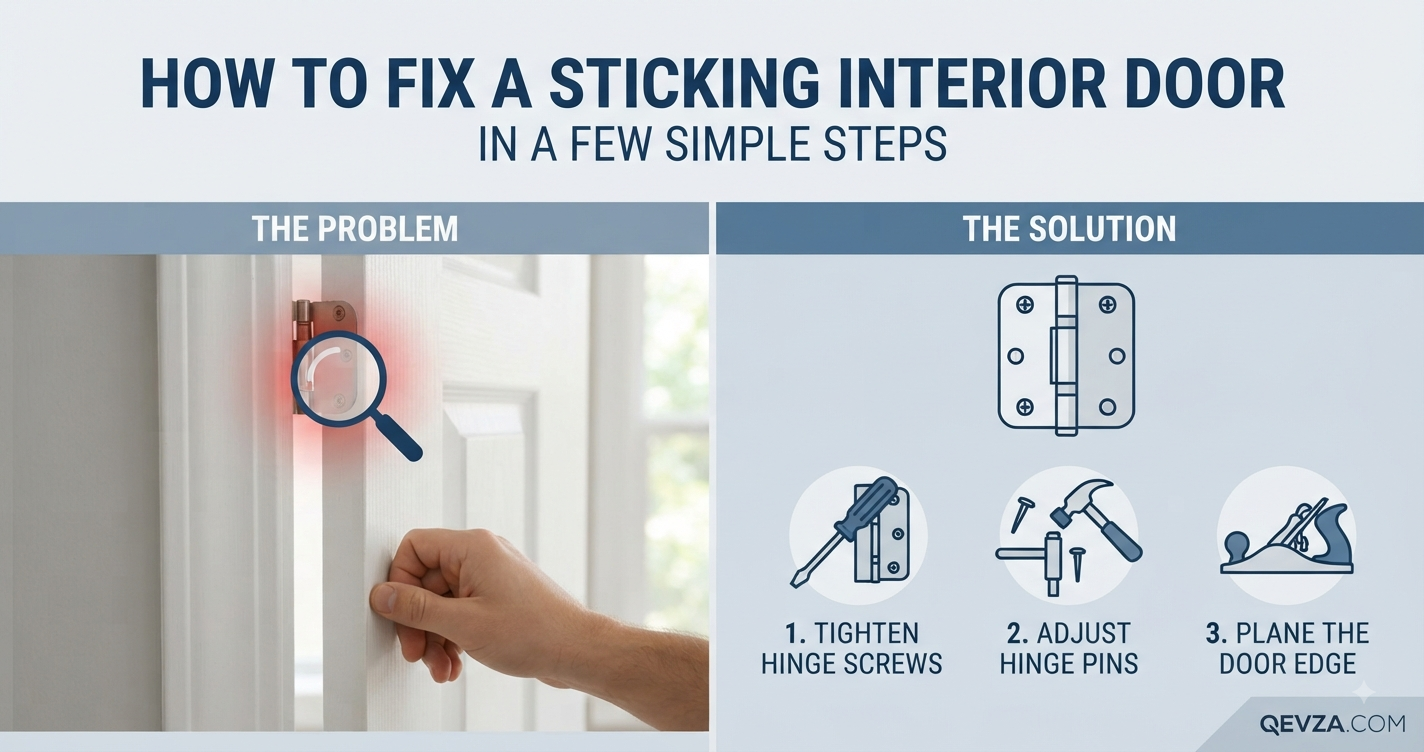
A door that sticks—whether it scrapes against the floor, binds against the side of the frame, or refuses to latch—is a common household frustration. Because doors are heavy and swing on precise hinges, even a tiny shift in the house foundation or a change in seasonal humidity can throw them out of alignment.
Before you reach for a sander or plane, understand that most sticking doors are simply sagging or swelling. This guide walks you through the diagnostic process to help you fix the issue with basic tools in under an hour.
What the Problem Usually Means
A door “sticks” when the clearance gap between the door slab and the door frame disappears. In a properly installed door, you should have a consistent gap about the thickness of a nickel (roughly 3mm) on all sides.
If the door rubs, it means that gap has closed due to the door sagging on its hinges, the door frame shifting, or the wood expanding. By locating exactly where the door makes contact, you can identify whether you need to tighten a hinge, adjust the frame, or remove a small amount of wood.
Common Reasons This Happens
Wood is a living material that constantly reacts to its environment. Most sticking doors stem from one of these three triggers:
-
Seasonal Humidity: In damp or humid climates, wooden doors absorb moisture and swell, causing them to rub against the frame even if the installation was perfect.
-
Loose Hinge Screws: The weight of the door constantly pulls on the top hinge. Over time, the screws in the door jamb work loose, allowing the top corner of the door to drop and drag against the floor or latch-side frame.
-
House Settling: Foundation movement—even minor, natural settling—can pull a rectangular door frame slightly out of square, creating tight spots at the top or bottom corners.
Step 1: Diagnose the Contact Point
Don’t start sanding immediately. Close the door slowly and watch the gaps.
-
Top corner rubbing: The door is likely sagging. Check the top hinge screws first.
-
Latch-side rubbing: The door may be warped or the hinges are loose.
-
Bottom edge dragging: The door is sagging, or high-pile carpeting/new flooring was installed with insufficient clearance.
-
Even rubbing all around: The door has likely swelled due to high humidity.
Step 2: The Easiest Fixes (Try These First)
Before removing material, use these non-invasive adjustments to restore clearance.
Tighten the Hinges
Most sticking doors are simply sagging.
-
Open the door and check the screws on the top hinge (both on the door and the frame).
-
Tighten them with a manual screwdriver. Do not use a power drill, as you can easily strip the wood fibers.
-
If the screw spins without tightening, the hole is stripped. Remove the screw, insert a wood glue-coated toothpick into the hole, snap it off flush, and drive the screw back in. The new wood provides the bite the screw needs.
The Hinge-Bending Technique
If the door still rubs after tightening, you can subtly shift the door position by bending the hinge knuckles.
-
Remove the hinge pin from the top or middle hinge using a hammer and a nail set or screwdriver.
-
Use an adjustable wrench to gently bend the knuckle on the frame side of the hinge slightly toward the interior of the room.
-
Replace the pin and test the door. This effectively “pulls” the top of the door closer to the hinge side, clearing the latch-side gap.
[Internal link opportunity: article about essential tools every homeowner should keep in a basic toolkit]
Step 3: Removing Material (The Last Resort)
If the door is still binding after hinge adjustments, you must remove a small amount of material. Only sand or plane the specific area that is rubbing.
-
Mark the spot: Use a pencil to mark the exact area on the door edge where the paint is scuffed or scratched.
-
Sand or plane: Use a block plane for major adjustments or medium-grit (80-grit) sandpaper on a sanding block for minor fixes.
-
Go slowly: Remove a thin layer of wood, then test the door. It is far easier to remove more wood than it is to fix a gap that has become too large.
-
Seal the raw wood: Once the door closes freely, apply a coat of matching paint or wood sealant to the exposed area. Raw wood absorbs moisture, which will cause the door to swell and stick again within weeks.
Common Mistakes to Avoid
-
Planing the whole side: Never plane the entire length of the door edge unless the entire side is binding. You only want to target the friction point.
-
Ignoring the hinges: Many beginners sand the door down immediately. If the issue was actually a loose screw, you will eventually fix the screw, but you’ll be left with an ugly, permanent gap between your door and the frame.
-
Over-sanding: Always check your work frequently. If you sand away too much, you will create a permanent light-leak gap that ruins the door’s soundproofing.
When You Should Call a Professional
Some door issues are structural and go beyond simple maintenance.
-
Cracked door frames: If the wood jamb is physically split or pulling away from the wall stud, the door structure is compromised.
-
Severe foundation issues: If every door in your home starts sticking simultaneously, your home may be experiencing significant foundation movement that requires a structural inspection.
-
Fire-rated doors: Never sand, plane, or alter a heavy-duty fire-rated door (common in apartment complexes). These are engineered to specific safety standards; modifying them can violate local fire codes.
How to Prevent the Problem in the Future
-
Manage Indoor Humidity: Keep your home’s relative humidity between 35% and 55%. Using a bathroom exhaust fan during showers and a dehumidifier in basements prevents wood from swelling.
-
Annual Hardware Check: Once a year, walk through your home and tighten hinge screws as part of your seasonal home maintenance routine.
Frequently Asked Questions
Can I use a belt sander to fix a sticking door?
Avoid it. Belt sanders are aggressive and difficult to control; they can easily gouge the door and leave uneven, wavy edges. Stick to hand tools or a small orbital sander for better precision.
Why does my door stick only in the summer?
This is caused by seasonal expansion. Wood absorbs moisture during humid summer months and swells. The problem often resolves itself in the winter when the air dries out and the wood shrinks back to its original size.
Should I lubricate the hinges?
If the door squeaks, yes. However, lubricating hinges will not fix a door that physically rubs against the frame. Focus on alignment first.