
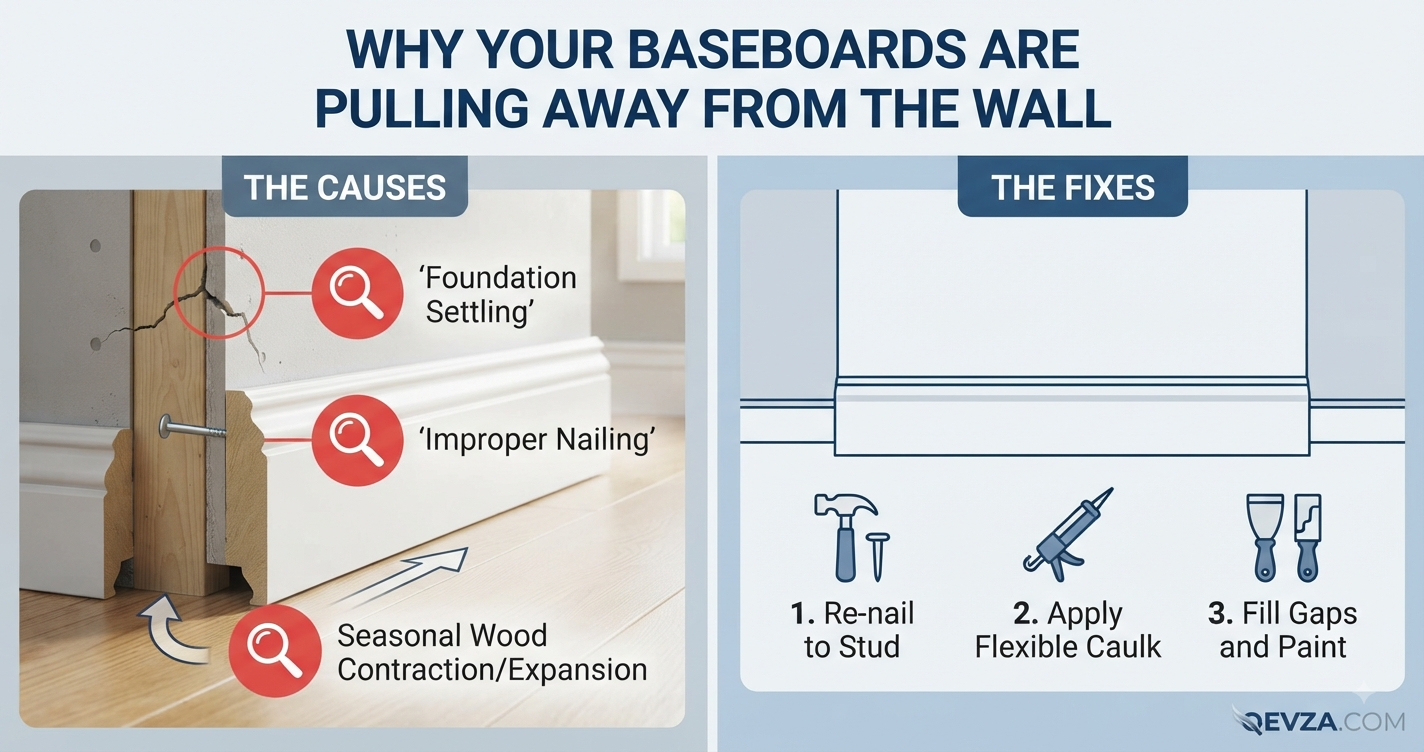
You notice a thin, dark line appearing between your baseboard and the wall. At first, it is barely visible, but over time, the gap widens until you can see the unfinished drywall edge behind the trim. It is a common eyesore, particularly in newer homes or rooms with fluctuating humidity.
While unsightly, baseboards pulling away from the wall are rarely a sign of your house falling down. This issue is almost always caused by the natural movement of wood and building materials reacting to environmental changes. Here is how to identify why it is happening and how to close those gaps for good.
What the Problem Usually Means
Baseboards are decorative trim pieces designed to hide the gap between your finished flooring and the wall. They are typically fastened to wall studs with finish nails and sealed at the top with caulk.
When you see a gap, it means the trim has physically moved or the wall behind it has shifted. This usually happens for one of two reasons: the wood trim is shrinking due to dryness, or the house structure is settling, causing the wall to pull away from the stationary trim. In either case, the bond between the paint, the caulk, and the drywall has snapped.
Common Reasons This Happens
Homes are dynamic structures. Throughout the year, materials expand, contract, and shift in response to the environment.
-
Seasonal Humidity Swings: Wood and medium-density fiberboard (MDF) are hygroscopic, meaning they absorb and release moisture. In winter, indoor air becomes extremely dry, causing wood trim to shrink. As it pulls inward, the caulk seal cracks and separates.
-
House Settling: As a home ages, the soil beneath the foundation may compress, or floor joists may settle under the weight of the structure. Even a fraction of an inch of movement can cause walls to pull away from the floor or trim.
-
Improper Fastening: If the original installer missed the wall studs and only nailed the baseboard into the drywall, the trim has no structural anchor. Over time, the weight of the trim—or the vibration of daily floor traffic—causes it to sag or pull away.
-
Subfloor Movement: If the floor joists underneath the subfloor flex, the wall plate (the bottom horizontal board of the wall) can shift, dragging the baseboard along with it.
What You Can Check Yourself
Before you start filling gaps, determine if the issue is purely cosmetic or indicative of a larger problem.
-
Check for soft spots: Press firmly on the wall above the baseboard. If the drywall feels soft or damp, or if the paint is bubbling, you may have a hidden water leak behind the wall.
-
Test the trim stability: Try to push the baseboard back against the wall with your hand. If it moves easily, the nails have likely pulled out of the studs.
-
Measure the gap: If the gap is wider than 1/4 inch, simple caulk will not hold. You will need to re-fasten the board using nails before finishing it.
[Internal link opportunity: article about signs of water damage in drywall]
How to Fix the Problem
For most homes, closing the gap is a straightforward afternoon project. The method depends on the size of the gap.
For Small Gaps (Less than 1/8 inch)
If the gap is just a hairline crack, you can re-seal it with high-quality paintable caulk.
-
Clean the area: Use a vacuum to remove dust and debris from inside the gap.
-
Apply caulk: Use a tube of flexible, paintable acrylic latex caulk. Apply a thin, steady bead along the top edge of the baseboard.
-
Smooth the bead: Run a damp finger or a small caulk smoothing tool along the line to force the material into the gap and create a clean, concave transition.
-
Touch up: Once dry (usually 2–4 hours), dab matching trim paint over the caulk line.
For Large Gaps (Greater than 1/8 inch)
If the board is physically pulling away, you must re-secure it before caulking.
-
Locate studs: Use a stud finder to mark the wall studs behind the baseboard.
-
Fasten the trim: Using a finish nailer or a hammer and 2-inch finish nails, drive new nails through the baseboard and into the center of the studs. This pulls the trim tight against the wall.
-
Hide the holes: Fill the nail heads with wood filler, let it dry, and sand it flush.
-
Caulk and paint: Follow the steps above to seal the top edge.
Common Mistakes to Avoid
-
Using Silicone Caulk: Never use 100% silicone caulk for baseboards. Paint will not stick to silicone, and you will be left with a permanent, shiny rubber line that cannot be color-matched. Always choose “paintable” acrylic latex.
-
Over-filling gaps: Do not try to pack caulk into a large, gaping hole. It will shrink as it dries and likely crack again. Always mechanical fasten (nail) the board first.
-
Ignoring the floor: If the gap is at the bottom of the baseboard, it is usually because the floor has settled. Do not caulk the bottom edge; this is where expansion space is needed. Use quarter-round or shoe molding to cover the gap instead.
When You Should Call a Professional
While most baseboard gaps are DIY-friendly, some signs suggest deeper issues.
-
Large diagonal cracks: If you notice large diagonal cracks in the drywall extending upward from the baseboard, your home’s foundation may be experiencing significant movement.
-
Consistent recurring gaps: If you fix the gaps and they reappear within weeks, there may be ongoing structural shifting or a localized moisture issue (like a slab leak) that needs a contractor’s assessment.
How to Prevent the Problem in the Future
-
Maintain Humidity Levels: Keep your home’s relative humidity stable between 35% and 55%. Using a humidifier in the winter months prevents wood trim from drying out and shrinking.
-
Use Flexible Sealants: When installing new trim, always use high-quality, flexible acrylic caulk rather than rigid construction adhesive, as it is designed to handle slight expansion and contraction.
Frequently Asked Questions
Why do my baseboards pull away in the winter?
Winter air is very dry, especially if you use central heating. Wood and MDF materials lose internal moisture, causing them to contract and shrink, which pulls the trim away from the wall.
Can I just use wood putty to fill the gap?
No. Wood putty does not flex. If the house shifts or the wood expands with the seasons, the putty will crack and fall out. Always use flexible, paintable caulk for joints between trim and drywall.
Should I caulk the bottom of my baseboards?
Generally, no. The bottom of the baseboard needs to be able to “float” slightly with the floor. If you caulk it to the floor, the seal will crack the moment the floor boards expand. Use shoe molding to hide bottom gaps.